1.1.1
Tung Chung New Town Extension
(TCNTE) (This Project) covers Tung Chung (East)(TCE) and Tung Chung
(West)(TCW), forms part of the Tung Chung New Town Extension (TCNTE). This
Project includes reclamation, site formation and engineering infrastructure
works (including construction of Road P1) for the developments of TCE,
construction of salt water pumping station and
infrastructure works in Tung Chung Area 58. The EIA Report for TCNTE
(AEIAR-196/2016) was approved in April 2016. 60507694/Z35/Figure 1 and 60507694/Z35/Figure 1.1 show the layout plans of TCNTE and TCE respectively.
1.1.2
This submission is to review the
use of new low noise road surfacing (LNRS) materials in TCE under Condition
2.23 of Environmental Permit (EP)(EP No. EP-519/2016).
For the submission for TCW, please refer to the project
website of TCW (https://www.env.tcnte-west.hk/en/ep-submissions.html).
This submission will be revised if there is any update of the information such
as the construction programme, the details of the noise mitigation measures, etc.
1.1.3
Subsequent to the approval of the TCNTE EIA, Executive Council endorsed to
enhance the development intensity of public housing sites to address land
supply shortage, under such circumstance, traffic noise impact assessment was
conducted to review traffic noise impact as a result of
the intensification policy on public housing sites in TCNTE. The assessment
result is presented in the reports “Traffic Noise and Railway Noise Impact
Assessments Review for Population Increase and Development Intensity – CASE 2
Scenario 2B (Ref. PI27-02)”. This report recommended application of Low Noise
Road Surfacing (LNRS) in some road sections on Roads D4, L4 and L5 (Ying Tung
Road).
1.1.4
This submission is to review
use of new LNRS materials in TCE within the TCNTE EIA and EP boundaries,
and shall cover the noise mitigation measures at Road L4, Road D4 and
Road L5 (Ying Tung Road) only. The review for the use of new LNRS material
elsewhere in TCE (including Road D3, Road L7 and Road P1) would be covered in
separate submission in view
of the roadworks programme of Q4 2026 or after (subject to site progress). Road sections of part of Ying Tung Road (lying between Ying Hei
Road and Road P1), Ying Hei Road and Tung Chung Waterfront Road not within
TCNTE EIA and EP boundaries are not covered in the review of this submission.
1.2
Scope of this Plan
1.2.1
In accordance with Condition 2.23
of the Environmental Permit (EP)(EP No. EP-519/2016), this
plan shall include at least the following information:
ii)
the extent and locations of
providing the new road surfacing material(s) for the roadworks covered by the
EP with justifications; and
iii)
reduction in traffic noise
impacts at specific sensitive receivers and minimization of the extent of noise
barriers for the roadworks covered by the EP as a resulting of applying the new
road surfacing material(s).
2.1.1
According to the “Interim
Report on the Use of 6mm Nominal Maximum Aggregate Size Polymer Modified Stone
Mastic Asphalt (PMSMA6) on Local Roads in Hong Kong” issued by Highways
Department (HyD) in June 2021, both overseas and
local experiences revealed that Polymer Modified Friction Course (PMFC),
attributed to its porous nature, is susceptible to wear and tear making it not
sufficiently durable as LNRS materials for many situations to sustain the local
road conditions. Therefore, PMFC is not taken as a structural layer and its
application on local roads will require laying on top of wearing course (“WC”)
instead of base course (“BC”).
2.1.2
The latest Guidance Notes on Low Noise Road Surfacing on Local Roads
(RD/GN/011E, April 2025) issued by the Highways Department supersede the
previous version RD/GN/011D. In this updated guidance, the binder of the
polymer modified stone mastic asphalt with 6mm nominal maximum aggregate size
(PMSMA6) has been upgraded with highly modified bitumen. With this enhancement,
the highly modified stone mastic asphalt with 6mm nominal maximum aggregate
size (HMSMA6) is designated as the new generation of Low Noise Road Surfacing
(LNRS) material for local roads in Hong Kong.
2.1.3
A new generation of LNRS
material, namely HMSMA6, is an enhancement of the previously tested PMSMA6
(Agreement No. Hy(S)Q/024/2016), in which the binder has been upgraded to
highly modified bitumen. Site trials on 18 local road sections commencing in
November 2023, together with laboratory tests conducted in collaboration with
The Hong Kong Polytechnic University, confirmed that HMSMA6 provides superior
overall performance compared with PMSMA6, particularly in terms of durability.
2.1.4
For environmental benefits,
HMSMA6 is a thin, non‑porous bituminous surfacing (typically about 30mm thick) made of
relatively fine and gap‑graded aggregates. Its optimized surface texture can reduce
road-type noise. The site trial results revealed that HMSMA6 achieves an
average noise reduction of approximately 2.5 dB(A), which is the same as PMSMA6
as referenced in RD/GN/011D, and its noise reduction ability would only be
materially reduced when substantial surface defects such as raveling
or potholes develop.
3.1
Road D4, Road L4 and Road L5 (Ying Tung Road)
3.1.1
Traffic Noise and Railway Noise
Impact Assessments Review for Population Increase and Development Intensity -
CASE 2 Scenario 2B (Ref. PI27-02).
proposed Low Noise Road Surfacing (LNRS), along Road D4, Road L4 and Road
L5 (Ying Tung Road) as part of the noise mitigation measures in TCE. The
locations of LNRS along Road D4, Road L4 and Road L5 (Ying Tung Road) are shown
in Figure 3.1, which is extracted from Case 2 Scenario 2B (Ref. PI27-02) - report
Appendix 2.4. The extents of LNRS at Road D4, Road L4 and Road L5 (Ying Tung
Road) are summarized in Table 3.2. Due to the site limitation, the extent of
LNRS will fall into the acceleration zone and braking zone. Notwithstanding,
the proposed scheme has been agreed with HyD/NT
Region for the extent under housing intensification to compile with relevant
noise criteria. Therefore, it is suggested that LNRS PMSMA6/ HMSMA6 could be adopted
for Road D4, Road L4 and Road L5 (Ying Tung Road).
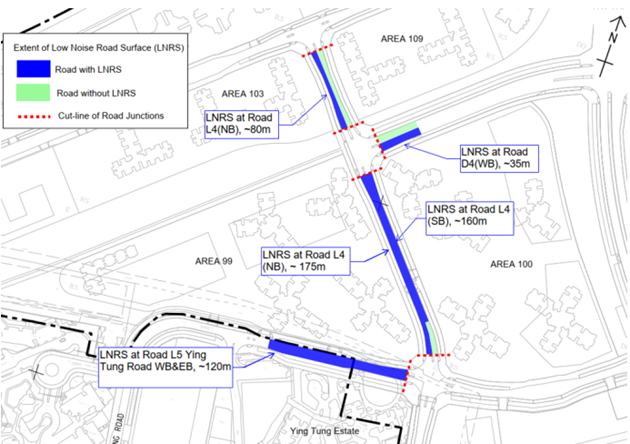
Remarks: For the LNRS at Road L4 between Area 99 and Area 100, the
LNRS at Road L4 (Northbound) is about 175m, while
the LNRS at Road L4 (Southbound) is about 160m.
WB = Westbound, EB =
Eastbound, NB = Northbound, SB = Southbound
Figure 3.1 – Locations and extents of the proposed
LNRS at Road L4, Road L5 (Ying Tung Road) and Road D4
|
Location
|
LNRS
|
|
Road D4 (Westbound) between
Area 100 and Area 109
|
~35m from cut-line of road junctions
|
|
Road L4 (Northbound)
between Area 103 and Area 109
|
~80m from cut-line of road junctions
|
|
Road L4 (Northbound)
between Area 99 and Area 100
|
~175m from cut-line of road junctions
|
|
Road L4 (Southbound)
between Area 99 and Area 100
|
~160m from cut-line of road junctions
|
|
Road L5 along Ying Tung
Road
|
~120m from cut-line of road junctions
|
Table 3.2 –
Extent of LNRS at Road D4, Road L4 and Road L5 along Ying Tung Road
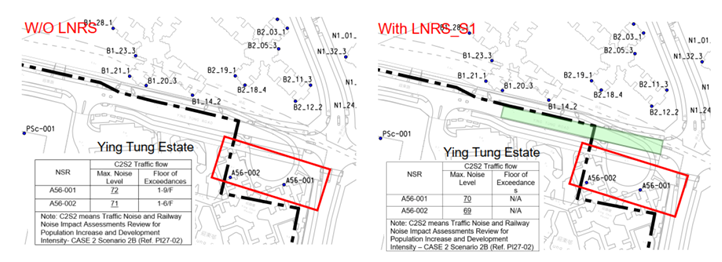
Figure 3.2 – Locations and extents of the proposed LNRS at Ying Tung Road (Road
L5)
3.1.2
Under the unmitigated scenario,
the maximum predicted noise level at Area 99, 100, 103 and 109 at Year 2045 is 73-74dB(A). For the existing NSRs
A56-001 and A56-002 of Ying Tung Estate, the maximum
unmitigated noise level is 72dB(A) and 71dB(A), respectively. With the implementation of LNRS shown in Figure 3.1, 3.2 together with additional at-receiver mitigation measures (e.g.
acoustic windows, architectural fins, etc.) at the planned sites recommended in
“Traffic Noise and Railway Noise Impact Assessments Review for Population
Increase and Development Intensity- CASE 2 Scenario 2B (Ref. PI27-02)”, the
maximum predicted noise level at Area 99, 100, 103 and 109, as well as the
existing NSR A56-001 and A56-002 of Ying Tung Estate will all comply with the
70dB(A) noise criteria, adverse noise impact would not be expected. No noise
barriers were proposed along Road D4, Road L4 and Road L5 (Ying Tung Road) in
CASE 2 Scenario 2B (Ref. PI27-02). The finalised mitigation measures at the
noise sensitive receivers shall be subject to further review by relevant authorities
and future developers under prevailing planning mechanism.
4. Summary and Way Forward


